

Weekly Threat Roundup: Week 46, 2026
Weekly Threat Roundup for 9 to 13 November 2026: an OpenSSH bypass that accepts any long password, 33 N-central zero-days and a platform pulled offline, Barracuda ESG chained to root, and the Fireworks AI breach.
On this page
SSH, the email security gateway and the remote management tool half the MSP world runs all let someone through this week, which is an uncomfortable list when those are the things meant to keep people out.
OpenSSH picked up an authentication bypass that accepts any long password on Alpine and similar systems, and it was on KEV within four days. Barracuda confirmed that two bugs in its Email Security Gateway are being chained to root. A researcher published 33 zero-days in N-able N-central with working exploits, and N-able took the hosted platform offline. And Fireworks AI, which runs models for other companies' AI features, confirmed a breach that exposed Notion customers' chat transcripts.
The week at a glance
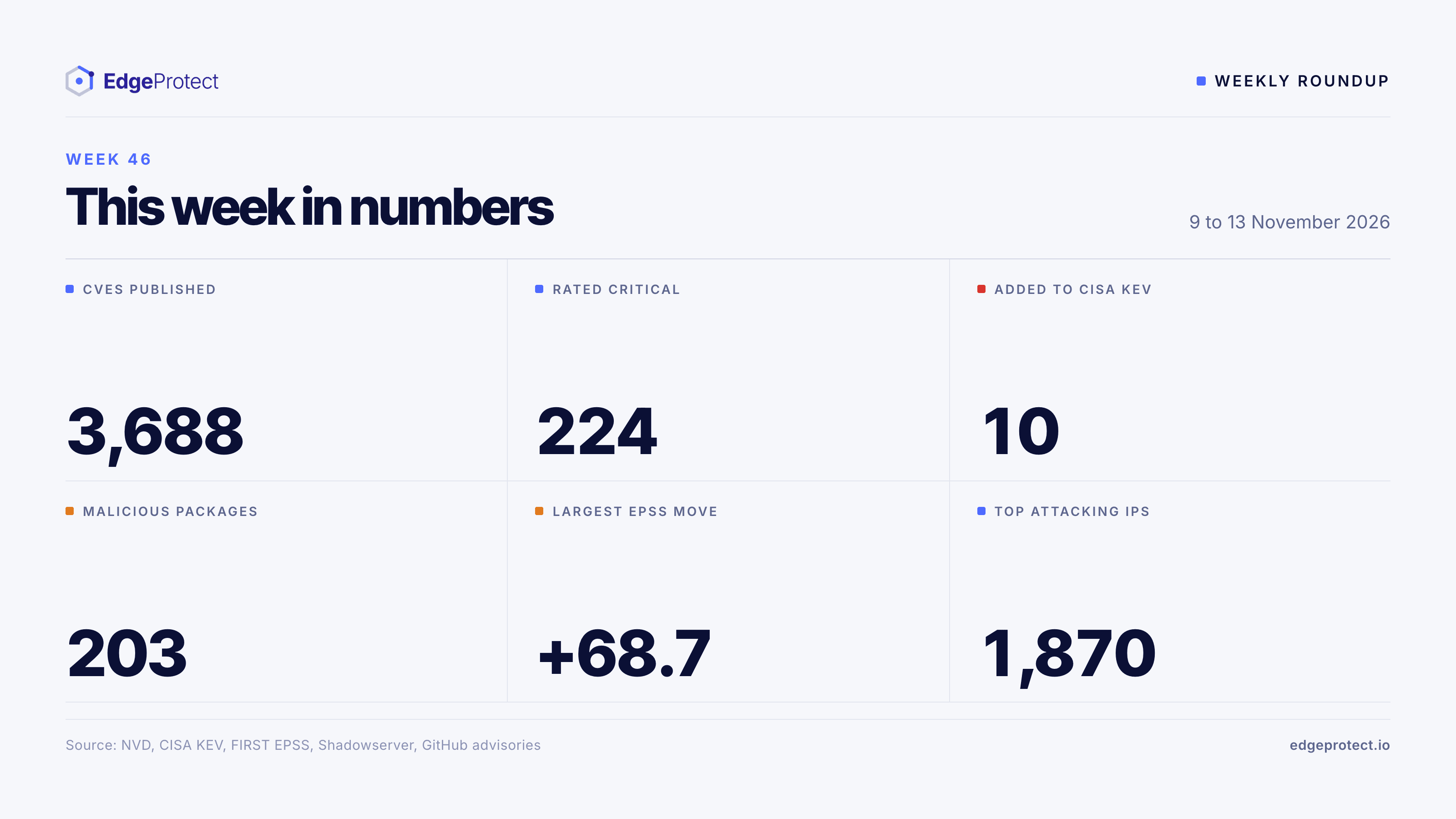
Between 9 and 13 November 2026 the NVD published 3,688 vulnerabilities: 224 critical, 1,817 high, 1,214 medium, 171 low and 262 not yet scored. That is up by more than half on last week's 2,322.
CISA added 10 CVEs to KEV, four on Monday and six on Tuesday, then nothing for the rest of the week.
Ransomware leak-site claims rose again. Groups posted 273 victims across 46 brands, up 16% on 235 the week before. N0n claimed 92 on its own, ahead of Storm-2697 on 22, Qilin on 14, and Inc Ransom and Curious Worm on 10 each. Healthcare and pharmaceuticals took 28 claims, manufacturing 25, and technology and telecommunications 23. The US accounted for 121, Canada 22, and Germany and the UK 9 each.
Any long password will do
CVE-2026-123158 is a password authentication bypass in OpenSSH before 10.6p2, and it only bites on Linux systems built on musl libc without PAM. Alpine's default openssh-server package fits that description, and so do OpenWrt, Buildroot and Yocto builds and a lot of Docker images. Debian, Ubuntu, Fedora and anything else on glibc are unaffected, as is Dropbear.
On an affected system, an account whose password field is just * accepts any password between 256 and 1,024 characters. The researcher who found it, Özgün Kültekin, traced it to two old decisions meeting: a 2016 OpenSSH fix that borrows another account's salt for locked accounts, and musl's handling of over-long passwords, which returns the same * the account already holds.
The fix shipped on 5 November. Previdian told Help Net Security its first attack attempt arrived less than nine hours after the CVE was published, against a honeypot running real Alpine, and that the attacker got root. CISA added it to KEV on Monday 9 November.
Two things catch people out. Installing the update does not restart the running sshd, so the old binary keeps accepting connections until you restart the service. And Alpine's official AWS and Azure images have a default alpine user with passwordless doas, which turns a login into root. If you cannot patch today, OpenSSH's Damien Miller says to set PasswordAuthentication no on affected systems straight away.
Exploited in the wild (CISA KEV)
Ten additions this week. The three to act on first:
- CVE-2026-123158: the OpenSSH bypass above, added 9 November 2026.
- CVE-2026-116606: Barracuda Email Security Gateway before 9.4.0.030, added 10 November 2026. An unauthenticated attacker can call the configuration-import function and restore a crafted backup, rewriting the appliance's global configuration.
- CVE-2026-111560: command injection through the timezone field in several Barracuda appliances, added 10 November 2026. It needs an administrator on its own, but the bypass above supplies the crafted value, and the result is commands running as root. Barracuda patched both on 2 November and confirmed on 9 November that the chain is being used against a small number of organisations.
Then the rest:
- CVE-2026-124194: Microsoft Outlook, added 10 November 2026. Opening a crafted message makes Outlook connect to an attacker's server without its usual warning, which can leak the user's NTLMv2 hash. The Preview Pane is not a route in. CISA's deadline is 24 November.
- CVE-2026-125350: a use-after-free in Chrome's XML handling, fixed in 157.0.8103.50.
- CVE-2026-20320: Cisco BroadWorks, where an unauthenticated XXE in the Open Client Interface lets a remote attacker read files from the server.
- CVE-2026-116779: FreeSWITCH before 1.11.3, where a crafted SIP MESSAGE reaches API commands and from there the operating system.
- CVE-2026-123218: IBM Aspera Faspex 5.0.0 to 5.0.19, where an authorised user can promote themselves to full administrator.
- CVE-2026-102895: GPUStack before 2.2.0, which trusted a spoofable loopback address as the built-in administrator.
- CVE-2026-111793: Openwave Webtop Media Transcoder, a bypass of administrator-set file type restrictions.
New vulnerabilities worth a look
The top six new CVEs by EPSS are all Zoho ManageEngine. Every one needs a login first, and every one sits on tooling with wide reach.
- CVE-2026-12507: authenticated remote code execution in the Reports module of ServiceDesk Plus before 15290, AssetExplorer before 7860, and ServiceDesk Plus MSP and SupportCenter Plus before 15150. Anyone with the Create Query Reports permission can run commands on the server. CVSS 9.1, EPSS 9.4%.
- CVE-2026-95646: DDI Central 6500 and below, where crafted Unicode characters in the Cisco IOS DHCP configuration get an operator's input run as device commands. CVSS 8.0, EPSS 3.9%.
- CVE-2026-12572: SQL injection in DDI Central's HA replication username handling, leading to command execution as the PostgreSQL service account. Fixed in 6201. CVSS 7.2, EPSS 3.4%.
- CVE-2026-12573: a DHCP pool name in DDI Central 6200 and below can carry Cisco IOS commands that run on managed routers. CVSS 8.8, EPSS 3.2%.
- CVE-2026-12062 and CVE-2026-76981: two authenticated SQL injections in ADAudit Plus, in the Reports API (fixed in 8703) and the custom reports module (fixed in 8711). Both CVSS 8.8, EPSS 2.9%.
Exploit probability movers
- CVE-2026-61511: vBulletin 5.x to 5.7.5 and 6.x to 6.2.1, an eval injection that gives unauthenticated attackers PHP code execution. Up from 5.6% to 74.3%, the biggest move of the week, and it is not on KEV.
- CVE-2026-75650: Adobe Commerce template injection, on KEV since September. Up from 34.7% to 99.4%.
- CVE-2026-59310: VMware vCenter, a directory traversal in the Syslog server that leads to code execution, on KEV since August. Up from 2.6% to 61.7%.
- CVE-2026-4408: Samba, command injection through the
check password scriptoption when it is configured with%u. Up from 2.5% to 46.9%. It only affects that non-standard setup, so check your smb.conf before you worry. - CVE-2026-18556: N-able N-central authentication bypass, on KEV since August. Up from 7.9% to 43.9%, in the same week the product had 33 new flaws published. More on that below.
What the honeypots saw
Shadowserver counts the unique source IPs attempting each exploit against its honeypots. That measures commodity scanning, which is a different thing from how many systems are actually exposed. Figures cover Monday 9 to Thursday 12 November.
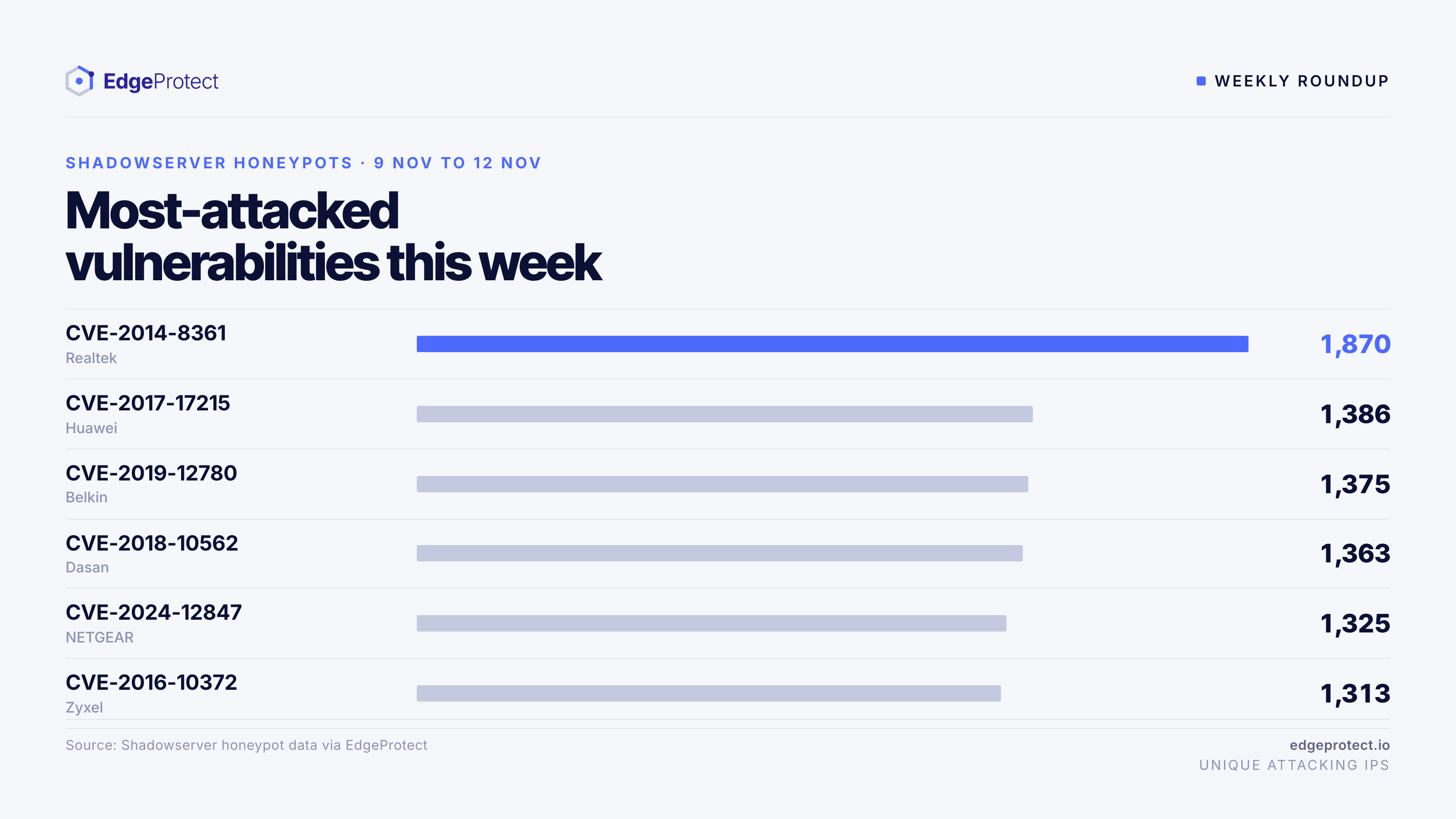
CVE-2014-8361, a Realtek SDK bug from 2014, came top with 1,870 unique IPs, up from 1,079 last week. Behind it were CVE-2017-17215 (Huawei) on 1,386, CVE-2019-12780 (Belkin) on 1,375, CVE-2018-10562 (Dasan) on 1,363, CVE-2024-12847 (NETGEAR) on 1,325 and CVE-2016-10372 (Zyxel) on 1,313. All six are home router and IoT bugs. The Belkin one is in a Wi-Fi slow cooker, and it had the busiest single day of the week with 712 IPs on Thursday.
By raw attempts over the last seven days, the busiest were CVE-2025-55182 in React Server Components with 64,642, CVE-2026-3055 in Citrix NetScaler with 55,653, and CVE-2018-13379 in Fortinet FortiOS with 46,490.
Software supply chain
203 malicious packages were flagged this week across npm, PyPI, RubyGems and crates.io. Most are spam, squats and dependency-confusion probes. These are the ones worth knowing about.
- A backdoored release of bee-js. On 9 November a malicious
@ethersphere/bee-js13.3.0 was published to npm through a compromised release identity. Its postinstall hook downloads and runs remote code, steals Swarm node keys and installs a persistent remote shell. If 13.3.0 reached a build machine, treat that machine's keys as gone. - A flood of Baileys forks. Tuesday's GitHub advisory sweep was dominated by forks of the Baileys WhatsApp library, alongside dependency-confusion probes aimed at Telefonica, ING and Fidelity and a PyPI Discord-webhook lure.
- Droppers and squats. Thursday's sweep had multi-stage droppers analysed by Amazon Inspector, a
tailwindcsstyposquat with an obfuscated payload, a PyPI RAT dropper and packages impersonating Redis and ioredis. - Rust crates reporting to Telegram. Friday's sweep had two crates.io infostealers,
basekandhesk, that send what they take to Telegram. The same sweep had a PyPI Windows dropper andmy-mcp-server-driving-license-ocr, an MCP tool that exfiltrates the personal data it is handed. - Infostealers on PyPI. Monday's sweep included an infostealer campaign under the chromacli name, more PyPI droppers, and RubyGems packages that beacon to oastify.com, which is usually someone's pentest.
Elsewhere this week: N-central goes dark
N-central is N-able's remote monitoring and management platform, the tool managed service providers use to run scripts, push patches and open remote sessions on their customers' machines. Late on Sunday 8 November, researcher Sean Bales published a GitHub repository called Able2Shell with 33 flaws in it and a working exploit for each. He told BleepingComputer he had reported bugs in another N-able product five or six months earlier, that they were still unpatched, and that he did not warn the company this time.
The worst chain starts with an unauthenticated XXE in the service-import function, steals a trusted local session, resets an account password and runs commands on the server. Another creates an enabled Default Administrator account with credentials the attacker chooses. Huntress counts four chains in all, three ending in remote code execution and one in root.
N-able opened a critical incident at 15:15 UTC on Monday, took hosted N-central offline across the Americas, Europe and Asia-Pacific, and told on-premises customers to shut their servers down. On Tuesday it shipped N-central 2026.4 HF2 (build 2026.4.1.26), which fixes seven CVEs including CVE-2026-125883, CVE-2026-125878 and CVE-2026-125882, and brought the hosted servers back.
That was not the end of it. Late on Wednesday Bales published two more sets of exploits tested against HF2. 4EverAble2Shell gives unauthenticated root on the server, and N-able says it only works when Legacy API is enabled and reachable. Agent2Shell goes after the way the server talks to its Windows Agents and Probes, and claims command execution as SYSTEM on managed endpoints. On Thursday, honeypots run by Previdian and Huntback caught the first attacks, and Huntback counted 21 N-central servers running an XMRig Monero miner, 19 of them on the HF2 build. N-able's own advisory that day said it had seen no signs of compromise, and Huntress has seen none among its partners.
If you run N-central on-premises, get to HF2, confirm Legacy API is disabled before the server goes back online, and keep it off the internet where you can. An IP allowlist is not enough on its own, because the affected endpoints are the ones Agents and Probes check in to. Then hunt from 8 November onwards: unexpected administrator accounts, an xvd.service systemd unit, files under /tmp/.xvd or /var/tmp/.xvd, and encoded PowerShell running as SYSTEM under the N-able agent.
If an MSP manages your estate, this is their problem and yours. Ask which RMM they run, whether it is patched, and whether they have checked for signs of compromise. Earlier N-central attacks this year ended with scripts and tools being pushed into customer environments.
Also this week: the AI supplier breach
Fireworks AI hosts and runs models for other companies, and it says it serves tens of thousands of customers. In late October an attacker got into its development environment by first breaching a third-party cloud provider, and took billing information, datasets and partial model weights for some customers. It was the second incident in two months: an earlier one in October exposed API keys and tokens stored as secrets for a limited number of accounts.
One of the datasets held Notion AI chat transcripts from Notion's Insights feature. According to BleepingComputer, Fireworks alerted Notion on 2 November to an exposed dataset that Notion was told contained only synthetic test data. Notion cut traffic to Fireworks and deleted its data there by 3 November, and on 8 November Fireworks confirmed that real customer data had been accessed. Notion says fewer than 1% of its users are affected, that most of the chats cannot be tied to an author or workspace, and that Fireworks had contractually committed to zero data retention.
Fireworks told TechCrunch it believes the attackers are financially motivated and were after model access they could resell.
If you use Notion AI, workspace owners can check Security incident review in Notion, and anyone affected should rotate passwords, API keys or tokens they pasted into a chat. If you are a Fireworks customer, rotate API keys and anything held in environment variables. For everyone else, it is a good week to list which AI vendors receive your prompts and data, and to ask each one what they keep.
What we'd do first
First, patch OpenSSH to 10.6p2 on anything built on musl, which means Alpine hosts and containers, OpenWrt and embedded Linux, and restart sshd afterwards. Where you cannot patch today, turn password logins off.
Second, if N-central is in your estate or your MSP's, get it to HF2, disable Legacy API and keep it away from the internet until N-able ships the next fix.
Third, get Barracuda Email Security Gateway to 9.4.0.030 or later and take its admin interface off the internet. The other Barracuda appliances need their own fix for CVE-2026-111560.
Fourth, roll out November's Outlook update and Chrome 157.0.8103.50.
Fifth, if vBulletin runs anywhere in your estate, patch it ahead of KEV. An unauthenticated code execution bug at 74.3% EPSS will not stay off the list for long.
Sixth, work through the Fireworks checklist above if Notion AI or Fireworks is in your stack.